
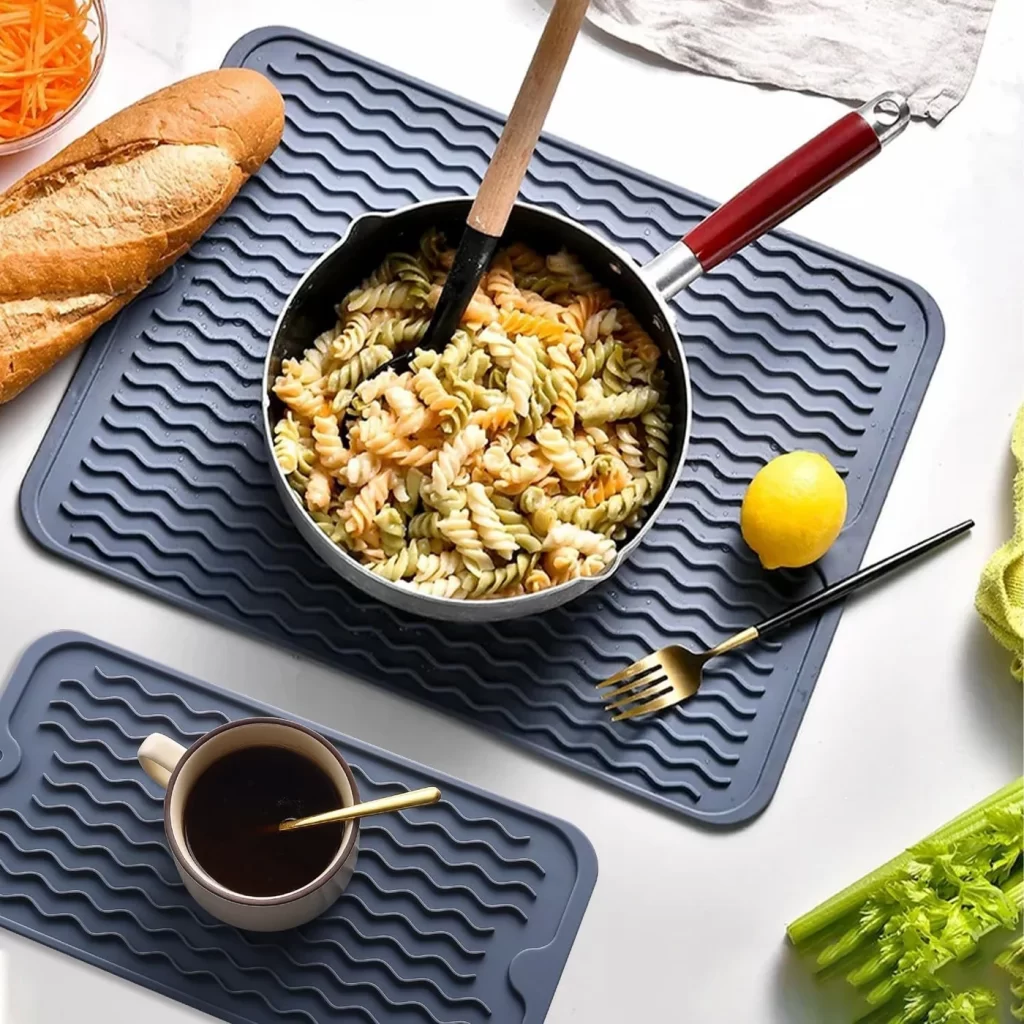
What a Silicone Heat Resistant Mat Actually Is
A silicone heat resistant mat is a flexible pad made from vulcanized silicone rubber, placed between a hot object and a surface that cannot take the heat. In a kitchen it sits under a pan straight off the hob; on a workbench it sits under a soldering iron; in a laundry room it sits under a hot iron.
The category is broader than most buyers expect, and the words shoppers use are not interchangeable:
| Term | What it means | Typical use |
|---|---|---|
| Trivet | A small pad or stand, usually 7×7 to 9×12 in | Under hot dishes and pans at the table |
| Pot holder | A silicone mitt or pinch grip | Handling hot cookware |
| Heat resistant mat | A larger flat sheet, 12×16 in and up | Countertop, air fryer, ironing, hair tools |
| Silicone baking mat | Food-grade sheet for oven trays | Baking, not surface protection |
If you are sourcing for retail, this distinction matters: a trivet listing that promises “countertop protection” competes with mats, and a mat that looks like a trivet gets returned for being too small.
What Heat Resistant Silicone Is Made Of
Two different materials sit under the same product name. They behave differently and should not be quoted as one.
1. Molded silicone rubber (VMQ)
This is the thick, three-dimensional pad — the trivet with honeycomb ribs, the mat with a raised lip. The compound typically contains:
- Methyl vinyl silicone gum — the base polymer
- Fumed silica — reinforcement; without it the rubber tears at 2 MPa
- Curing agent — peroxide for solid silicone, platinum catalyst for liquid silicone (LSR)
- Iron oxide or cerium oxide — heat-ageing additives that slow hardening at high temperature
- Pigment — usually 2–5% by weight
A well-formulated compound holds its hardness for years at 200°C. A cheap one — more filler, less silicone gum — goes brittle in months, which is exactly the “it cracked after a year” review you see on marketplace listings.
2. Silicone-coated fiberglass cloth
This is the thin, flexible sheet — 0.2 to 1.0 mm — used for ironing pads, heat press sheets and industrial barriers. Woven glass fibre gives it mechanical strength; the silicone coating gives it release and heat resistance.
The compound behind most coated heat-barrier sheet reads like this: alkali-free ultrafine glass fibre as the carrier, room-temperature-vulcanising (RTV) silicone rubber as the coating, fumed silica as reinforcement, iron oxide as a heat-ageing additive, and hydroxyl silicone oil as a viscosity and structure-control agent. That five-ingredient recipe is what delivers the low thermal conductivity and the flat, draping sheet — it is not the recipe for a molded trivet.
It survives higher surface temperatures than molded silicone (short excursions to 250–300°C are normal) but it has no structure. It cannot be molded into a ribbed trivet, and it will fray at a cut edge unless the edge is sealed.
| Property | Molded silicone pad | Coated fiberglass cloth |
|---|---|---|
| Thickness | 2–6 mm | 0.2–1.0 mm |
| Continuous heat | –50 to 230°C | –70 to 260°C |
| Structure | 3D, ribbed, lipped | Flat, drapes |
| Cut edges | Clean | Must be sealed |
| Best for | Trivets, countertop mats | Ironing, heat press, insulation |
How They Are Made: Five Steps
Step 1 — Compounding
Silicone gum, fumed silica, curing agent, heat stabiliser and pigment are mixed on a two-roll mill or in an internal mixer, then sheeted out. This is where cost is decided: filler loading up to 40% cuts the price and the service life at the same time.
Step 2 — Forming
Three routes, chosen by volume and shape:
- Compression molding — a pre-weighed blank is pressed in a heated mould at 160–180°C. Cycle time runs 5–15 minutes depending on thickness. This is the standard route for trivets and ribbed mats.
- Liquid silicone injection (LSR) — platinum-cured, cycle time measured in seconds. Higher tooling cost, better for high-volume thin parts.
- Calendering — silicone is spread onto glass cloth and cured in a tunnel oven. This is how coated fabric is made, not molded pads.
Step 3 — Vulcanizing
Heat turns the gum into an elastic network. Under-cured parts feel tacky and will bleed oil; over-cured parts tear at the edge. Both are invisible in a photo and obvious in a dishwasher three months later.
Step 4 — Post-curing
Finished parts are baked again at around 200°C for 2–4 hours. This drives off volatile siloxanes — the single most effective step against the “chemical smell” complaint that accounts for roughly 12% of negative reviews across silicone drinkware and kitchen products. Factories that skip post-curing ship faster and get returned more.
Step 5 — Trimming and QC
Deflashing, then checking thickness, hardness (Shore A), colour match and dimensional tolerance. A 4 mm mat that measures 3.6 mm loses 10% of its insulation and is usually the difference between two quotations.
Performance: What the Numbers Mean
| Property | Typical value | Why it matters to a buyer |
|---|---|---|
| Continuous service temperature | –50 to 230°C | Safe under a pan off the hob; not for direct flame |
| Short-term peak | 250–300°C | Seconds, not minutes |
| Hardness | Shore A 40–70 | Softer grips better; harder resists compression set |
| Density | 1.1–1.3 g/cm³ | Higher = more silicone, less filler |
| Tensile strength | 5–9 MPa | Below 5 MPa tears at the hanging hole |
| Thermal conductivity | 0.2–0.3 W/m·K | Low, but a 2 mm mat is a barrier, not an insulator |
| Tear strength | 15–30 kN/m | Decides whether the ribbing survives washing |
One number matters more than the rest: 230°C continuous. That is roughly 445°F, comfortably above a cast-iron skillet leaving a 220°C oven, and well below the 300°C+ where silicone starts to decompose into white ash. If a supplier quotes 300°C continuous on a molded pad, they are quoting a peak value — ask for the test report.
Product Profile: What the Finished Pad Actually Does
Spec sheets settle the shortlist, but the end user judges a heat mat on the things they touch, wash and smell. These are the properties worth putting on a listing — or on a quotation:
| Property | What it means in use |
|---|---|
| Odourless and non-toxic | No smell out of the bag; the result of proper post-curing, not a slogan |
| Dust-resistant | A non-porous surface does not hold flour, dust or lint |
| Non-permeable | Liquid and grease cannot soak in, so stains stay on the surface |
| Soft, anti-slip, shock-absorbing | Grips a smooth worktop and cushions a dish set down harder than intended |
| Waterproof | No swelling, no delamination after repeated washing |
| Heat and cold stable | –50 to 230°C covers freezer through oven |
| Ageing and fade resistant | Colour holds after a year of dishwasher cycles and daylight |
| Solvent, acid and alkali resistant | Kitchen cleaners and spilled vinegar do not swell or chalk it |
| Recyclable and reusable | Silicone can be reground; this is not a single-use item |
| Multi-colour | Colour-coding identifies size and use, and makes end-of-life sorting practical |
Two of these deserve a note. Oven, microwave and freezer safe is true of molded silicone within kitchen temperatures — a mat can go into a 200°C oven, into a microwave, and into a –18°C freezer without changing shape or hardness. What it must never do is sit on a hob, under a grill or on an induction coil. And colour is not decoration: in food-service and promotional orders, colour coding (red for meat, green for vegetables, blue for fish) is often why a buyer specifies four SKUs instead of one — and it is also why silicone products are easier to sort for recycling than mixed plastics.
Where They Are Used
Kitchen: trivets, pot holders and countertop protection
The core application. A 3–4 mm ribbed pad under a casserole protects laminate and quartz; a 9×12 in mat under an air fryer catches drips and stops heat marking the counter. Magnetic versions — with ferrite strips molded into the back — stick to the hob surround or the fridge, which solves the “where do I keep this thing” problem that kills repeat purchase.
Kitchen utensils and bakeware
Most factories that mold trivets mold the rest of the drawer too — silicone spatulas, spoons and ladles, stretch-lid food covers, pastry and oil brushes, mixing scrapers and balloon whisks. The heat resistance is the same; what changes is hardness (utensils sit nearer Shore A 60–70 so they do not fold under load) and the food-contact certificate, which has to cover the whole item, not just the working end.
Air fryers and toaster ovens
Air fryers exhaust hot air downwards. A mat under the unit protects the counter from both heat and grease; the same pad doubles as a resting place for the basket, which is why bundle listings outsell single mats.
Ironing and hair tools
Coated fibre cloth, not molded silicone, is the right material here — thin enough to fold into a drawer, tolerant of a 200°C soleplate pressed on it for minutes. Curling irons and flat irons use the same construction at a smaller size.
Sealing parts, feet and industrial barriers
The same compound and the same presses also produce parts that never see a kitchen: O-rings and sealing rings, gaskets and shims, bottle stoppers, waterproof washers, rubber feet, protective sleeves and cup sleeves, plus heat barriers under motors. In this category the specification is a drawing rather than a colour, tolerances tighten to ±0.2 mm, and the conversation is about compression set and media resistance rather than aesthetics.
Gift and promotional items
Branded trivets are a practical corporate gift: low unit cost, high daily visibility, and a surface large enough for a clean logo. Silkscreen works on flat mats; for ribbed trivets, a debossed or moulded-in logo reads better than print.
The wider silicone gift range runs on the same equipment — wristbands, ice cube trays, keychains, coasters and pads, watch straps, insoles, phone sleeves and charms, lanyards, ashtrays, name badges and promotional figurines. Buyers who order a trivet and a wristband from the same factory consolidate tooling, colour matching and shipping, which is usually worth more than a few percent off the unit price.
A Closer Look: The 16 x 12 in Foldable Silicone Mat
The mat behind the numbers in this guide is a moulded silicone drainboard rather than a small trivet, so it covers more of the counter than a 7 x 7 in pad. Two sizes come from the same mould family: 16 x 12 in (40 x 30 cm) for a full dish rack or a countertop run, and 12 x 6.1 in (30 x 15.5 cm) for a sink edge, a draining board corner or a single pan.
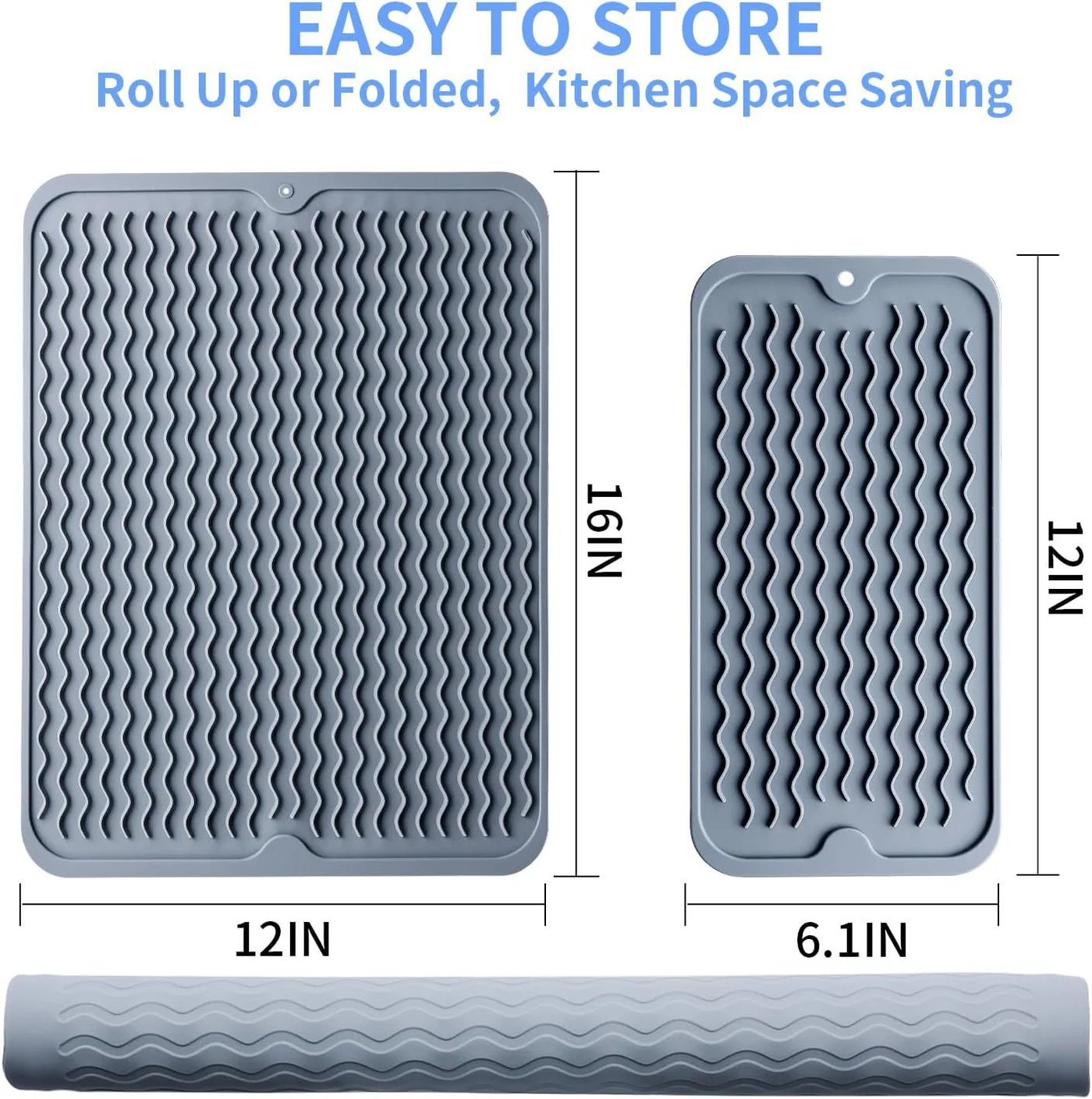
Four details do the work. Wavy ribs lift glassware and hot bases off the surface so water runs beneath them instead of pooling; a raised perimeter keeps that runoff on the mat rather than the countertop; a textured base grips a wet worktop; and a moulded hole at one end lets the mat hang over the tap. It rolls or folds, which is why it lives in a drawer instead of holding counter space all year.
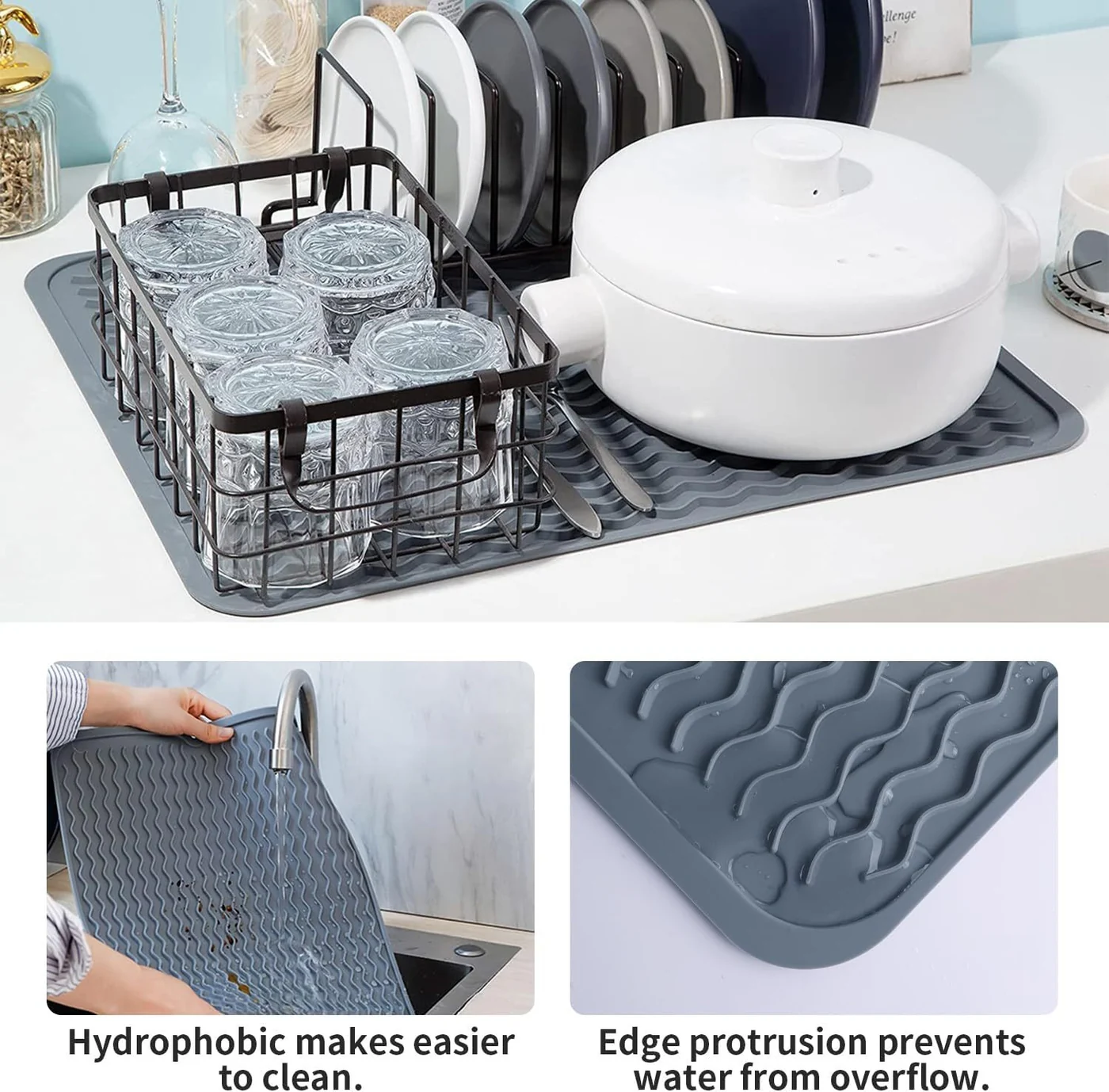
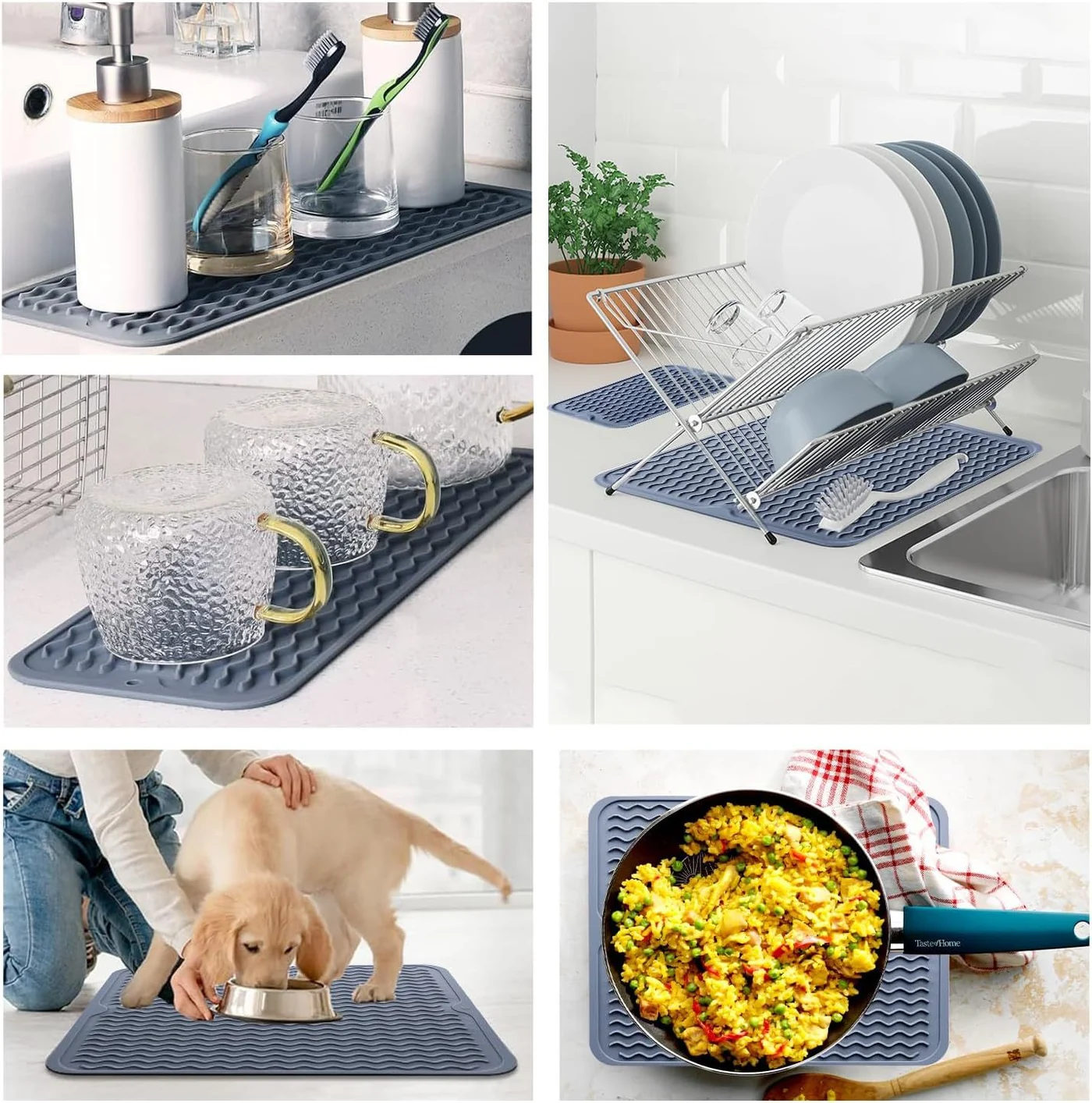
Two things are worth writing into a quotation: material and rating. Food-grade silicone, rated to 220°C (428°F), dishwasher safe on the top rack, supplied in grey-blue. Within those limits the same piece works as a dish drying mat, as a drainboard under a rack, as a rest for mugs, and as a heat resistant mat for a pan taken straight off the hob — the four jobs are shown below.
For a custom order, the variables that move unit price are thickness, hardness and the number of colours in the run; the mould is a one-off tooling cost. Minimum quantity, colour matching and logo placement are covered on the contact page.
How to Choose: A Buyer’s Checklist
- Thickness first. 2 mm for light countertop protection, 3–4 mm for a general trivet, 6 mm for heavy cast iron or commercial kitchens.
- Size by use. 7×7 in for a teapot, 9×12 in for a casserole, 16×12 in for a countertop run.
- Hardness. Shore A 50–60 is the sweet spot: stiff enough not to slump under a full pan, soft enough to grip.
- Temperature claim in writing. Ask for continuous, not peak, and for the test method.
- Edge design. A raised lip contains spills; a flat edge is easier to wipe.
- Hanging hole or magnet. Both extend product life by keeping the mat off the counter.
- Certification. FDA 21 CFR 177.2600 for the US, LFGB for the EU, plus RoHS if the product carries pigment. Ask for the certificate number, then check it — borrowed certificates are common.
- Post-cure confirmation. Ask directly whether parts are post-cured and for how long. It is the cheapest question with the biggest effect on smell complaints.
Care and Cleaning
Dishwasher-safe on the top rack. Avoid knives and steel wool — silicone cuts and the cut edge traps food. For baked-on grease, soak in warm water with baking soda, then wipe. Do not put a mat directly on a gas flame or an electric coil; silicone conducts heat slowly but it does not enjoy 800°C.
Frequently Asked Questions
How hot can a silicone heat resistant mat get? Molded silicone pads are rated for continuous use at 230°C (445°F), with short peaks to 250–300°C. Above roughly 300°C silicone starts to break down and leave a white residue. Coated fibreglass cloth tolerates slightly more.
Can I put a pan straight from the oven onto a silicone trivet? Yes, up to the rated temperature. A pan at 220°C is well within range. Never place a mat over an open flame or a hot burner.
Do silicone mats melt? They do not melt like plastic — silicone is already cross-linked. It degrades by hardening and, above 300°C, turning to ash. There is no liquid stage.
Silicone, cork or wood trivet — which is better? Silicone grips better, washes in a dishwasher and does not stain. Cork insulates slightly better and is cheaper. Wood looks better on a table but scorches and needs oiling. For a countertop under an air fryer, silicone wins on cleaning.
Are silicone mats food safe? Food-grade silicone is BPA-free and inert. Confirm FDA or LFGB compliance with a certificate number rather than a logo on the packaging.
Why does my silicone mat smell? Volatile siloxanes left from incomplete post-curing. Wash in warm soapy water and air it for a few days; if the smell persists after that, the compound itself is the problem.
Conclusion
A silicone heat resistant mat looks like a commodity, but three variables decide whether it lasts: how much real silicone is in the compound, whether the part was post-cured, and whether the quoted temperature is continuous or peak. Get those right and a 3 mm pad will outlive the countertop it protects.
If you are developing a trivet, countertop mat or coated fibreglass sheet for retail or promotional use, talk to our team about thickness, hardness, colour matching and logo application — samples with your specification are usually the fastest way to settle a quotation.